

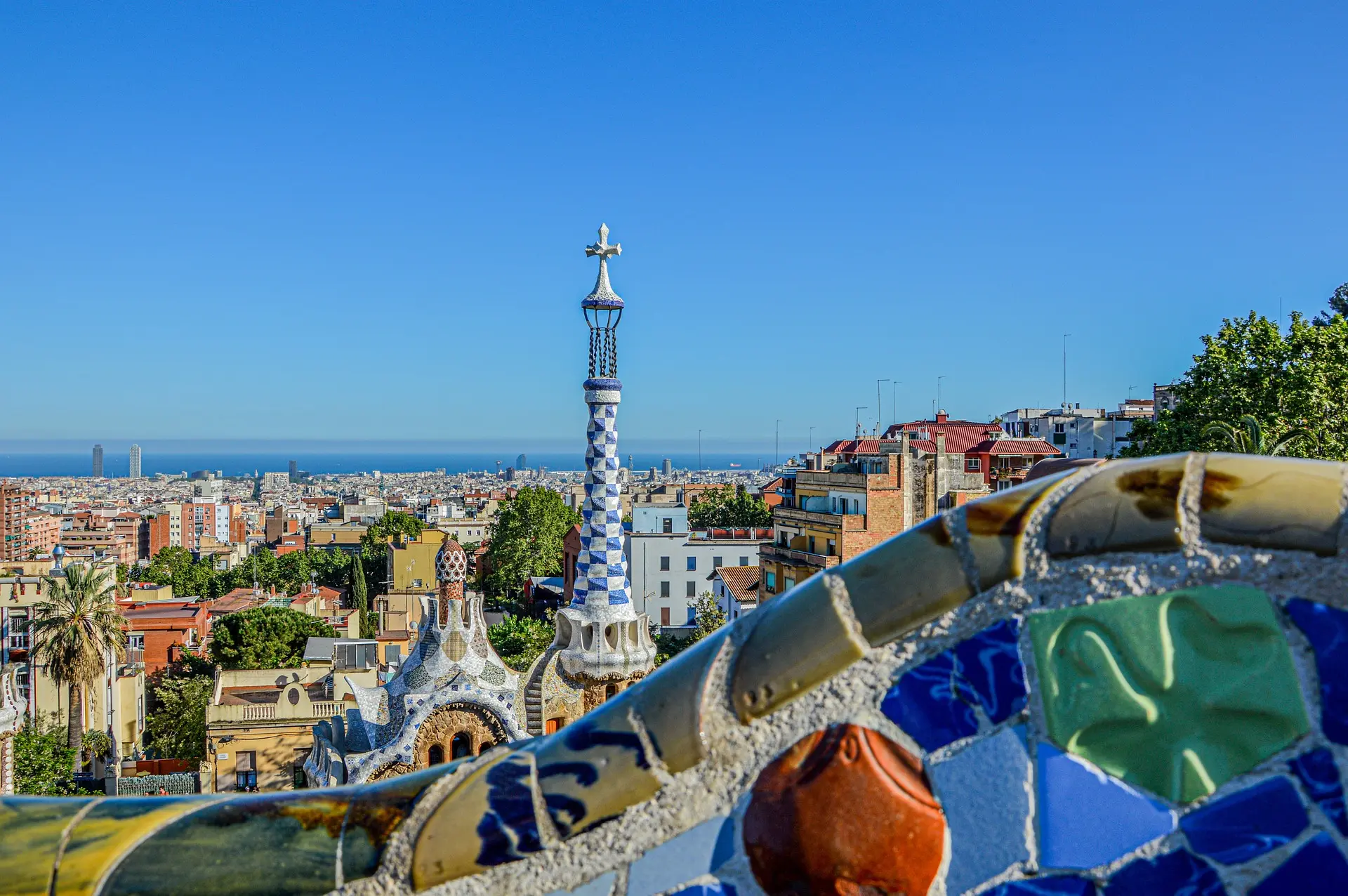
Gaudí Masterpieces
The architect who bent the rules of nature
Antoni Gaudí did not believe in straight lines. He said they belonged to humans and curves belonged to God, which is either profound or slightly unhinged depending on your relationship with geometry. Either way, the results are all over Barcelona, and they make every other building look like it is just trying to be a box.
Casa Batlló on Passeig de Gràcia is the one that stops traffic. The facade ripples like water. The balconies look like skulls or masks or something from the bottom of the ocean — interpretations vary, and Gaudí never clarified. The roof is scaled like a dragon’s back, with a cross piercing the spine. Inside, the central light well is tiled in graduating shades of blue, darker at the top, lighter at the bottom, so that natural light distributes evenly on every floor. He thought about everything. He thought about light falling through a stairwell the way most people think about what to have for lunch.
A few blocks away, Casa Milà — La Pedrera — is the building that made the neighbors angry. When it was finished in 1912, locals called it “the quarry” because they thought it looked like an open-pit mine. The tenants complained that no room had a right angle, which made it impossible to place conventional furniture. Gaudí designed furniture specifically for the building. The tenants were not particularly grateful.
On the rooftop, the chimneys are helmeted warriors, standing in clusters, staring out over the city. Nobody knows exactly what Gaudí intended them to guard against. The ventilation shafts twist like soft-serve ice cream. The whole rooftop feels like a set from a film that has not been made yet.
And then there is the Sagrada Família, which Gaudí knew he would not live to finish. Construction began in 1882. He died in 1926, struck by a tram, and the building was perhaps fifteen percent complete. Almost a century later, it is still not done. The Nativity facade is his — every figure, every leaf, every snail on the stone was placed with intention. The Passion facade, completed later, is stripped and angular, almost brutal.
Eight stops across the city trace the arc of a man who built like no one before or since.
What you'll discover
·The building where not a single wall is straight — by design
·A rooftop of warrior chimneys guarding against something Gaudí never named
·The Sagrada Família's facade that tells the Christmas story in stone
·A lamppost on Passeig de Gràcia — Gaudí's forgotten first public commission
·The apartment block where tenants complained about living in a work of art
·A hidden courtyard inside Casa Milà that changes color as you climb
·The park that was meant to be a housing development and failed beautifully
Before you go
Best time
Morning. The light on Casa Batlló is best before noon.
Getting there
Metro L3/L5 to Diagonal. Start at Passeig de Gràcia.
Duration
60 minutes of narration. Allow 2-3 hours with photo stops and exterior gazing.
Footwear
Comfortable walking shoes. You'll cover 3.5 km across Eixample's grid.
€4.99
This walk. 14 days.
Or all 10 Barcelona walks for €27.99
Open in app2 devices. One can be a friend's.
More in Barcelona
Eixample: Modernisme Beyond Gaudí
The grid that hides a revolution
Montjuïc: Castle to Culture
The mountain with all the views
Gothic Quarter Highlights
The medieval maze in 25 minutes
La Rambla Experience
Beyond the tourist trap